آلات
Arabic Music Instruments: Names, Sounds and the Takht
Arabic musical instruments come together in an ensemble called the takht, with some carrying the melody and others setting the rhythm. Here we introduce the qanun, ney, darbuka, and riq and explain how to tell them apart by ear.
What Is a Takht, and Who Plays in It?
The takht is the basic ensemble in Arabic music. In Egypt, Syria, Lebanon, Palestine, and Jordan, it consists of the oud, qanun, kamanjah or violin, ney, riq, and darbuka. It usually has two to five musicians. A larger ensemble of eight or more people is called a firqa.
The violin entered the takht in the 1840s or 1850s, making it a relatively recent addition. It can take the place of the kamanjah, showing that the takht's lineup is flexible. The roles are clearly defined: the oud, qanun, kamanjah, violin, and ney carry the melody, while the riq and darbuka provide the rhythm. Knowing these roles makes it easier to hear which instrument is leading the piece at any given moment.
The Qanun: A Stringed Instrument of Arabic Music
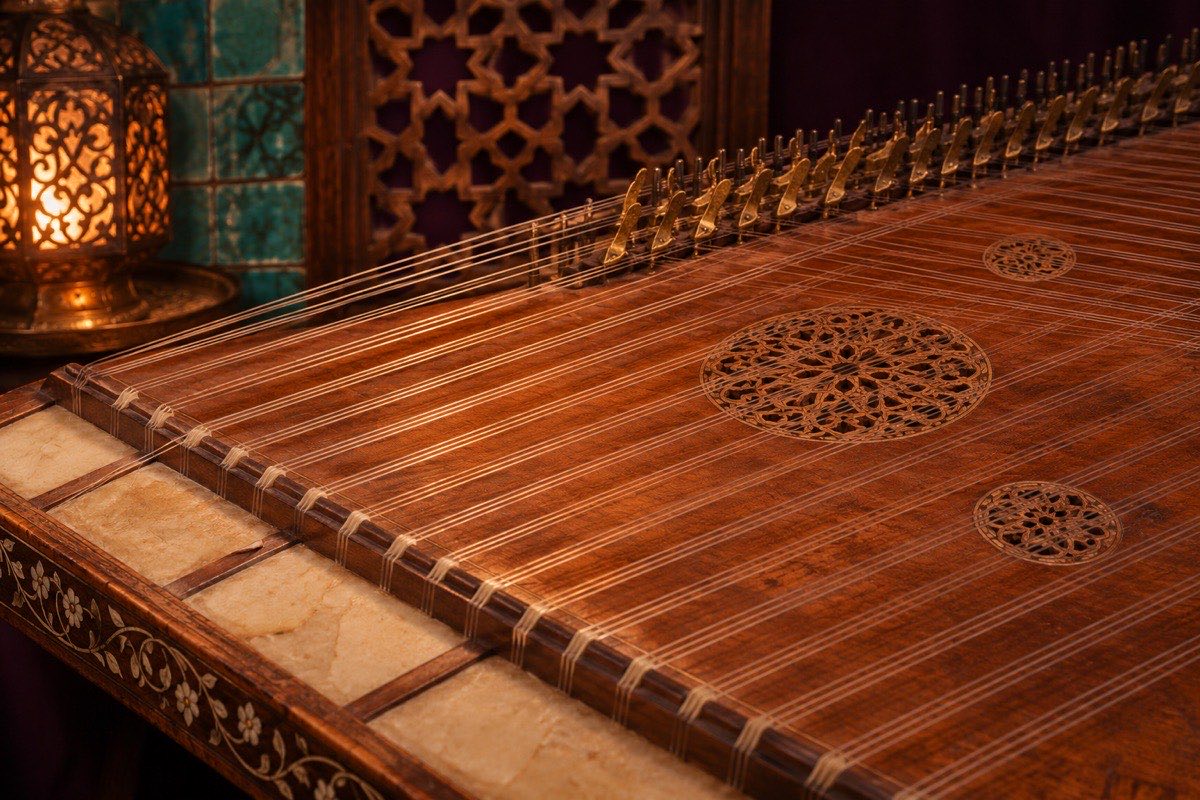
The qanun is a large zither with a thin, trapezoidal soundboard. Its name comes from the Greek word kanon, meaning a rule or norm. This distinctive shape makes the qanun one of the easiest Arabic stringed instruments to recognize by sight.
The qanun's construction varies by region. Arabic qanuns usually have five skin insets that support one long bridge, while Turkish ones have four. The strings are arranged in groups of three, called courses, and Turkish instruments usually have 26 courses. The qanun also allows musicians to play the microtones of the maqamat precisely. You can read more about these in our article on the maqam system.
The Ney: A Cane Flute from Ancient Egypt
The ney is an end-blown flute made of cane. The Arabic version is played without a mouthpiece and usually has six holes in the front and one in the back. Its history stretches back more than 4,500 years, with people playing it as far back as ancient Egypt.
Like the qanun, the ney can produce the microtones of the maqamat precisely and serves as one of the takht's melodic instruments. Both instruments are well suited to melodies based on the maqamat, though their sounds are quite different: one produces music with strings, while the other is a cane flute.
Darbuka, Riq and Darbuka Rhythms
The darbuka is a goblet drum with a single membrane. Its name comes from the Egyptian word darb, meaning "to strike." People often ask about the difference between a darbuka and a doumbek. The answer is simple: they are two names for the same type of drum. Other names include tabla and tarabuka.
Playing style depends on the instrument's shape. The Egyptian style has rounded edges around the membrane, which favor fast tremolos. The Turkish style leaves the membrane's rim exposed, allowing finger-snapping techniques.
The darbuka produces three basic sounds. Doum is a deep bass sound made by striking the center of the membrane. Tak is a high sound made by striking near the rim with the fingers. The third sound is the closed pa, also called sak. You can hear the difference between doum and tak right away: the low bass contrasts clearly with the high note. These three sounds form rhythmic patterns called awzan in Arabic music, meaning "weights." Popular darbuka rhythms include maqsum, baladi, and malfuf.
The riq is a frame drum with jingles, a type of tambourine used in the takht ensemble. Together with the darbuka, it forms the rhythm section, adding a clear ring to the darbuka's strokes. For a broader look at the music these instruments accompany, see our article on Arabic music genres.
How to Recognize Arabic Music Instruments by Ear
Start by listening for the melody and rhythm separately. The qanun is a stringed instrument, the ney is a cane flute played without a mouthpiece, the darbuka alternates between bass and high strokes, and the riq adds a jingle. Comparing these sounds is a useful way to learn to recognize Arabic musical instruments, since each produces sound differently. Remember, too, that the instruments play together in a takht, so a single piece lets you hear how melody and rhythm work together. Put on a recording and try listening for each instrument in turn, paying attention to its sound and its role in the ensemble.