عود
Oud Instrument: Origin, Tuning and Oud vs Guitar
The oud instrument is a fretless Middle Eastern lute with a pear-shaped body and a short neck. This article explores its origins, its tuning, and how it compares with the guitar.
What Is the Oud Instrument, and How Do You Pronounce Its Name?
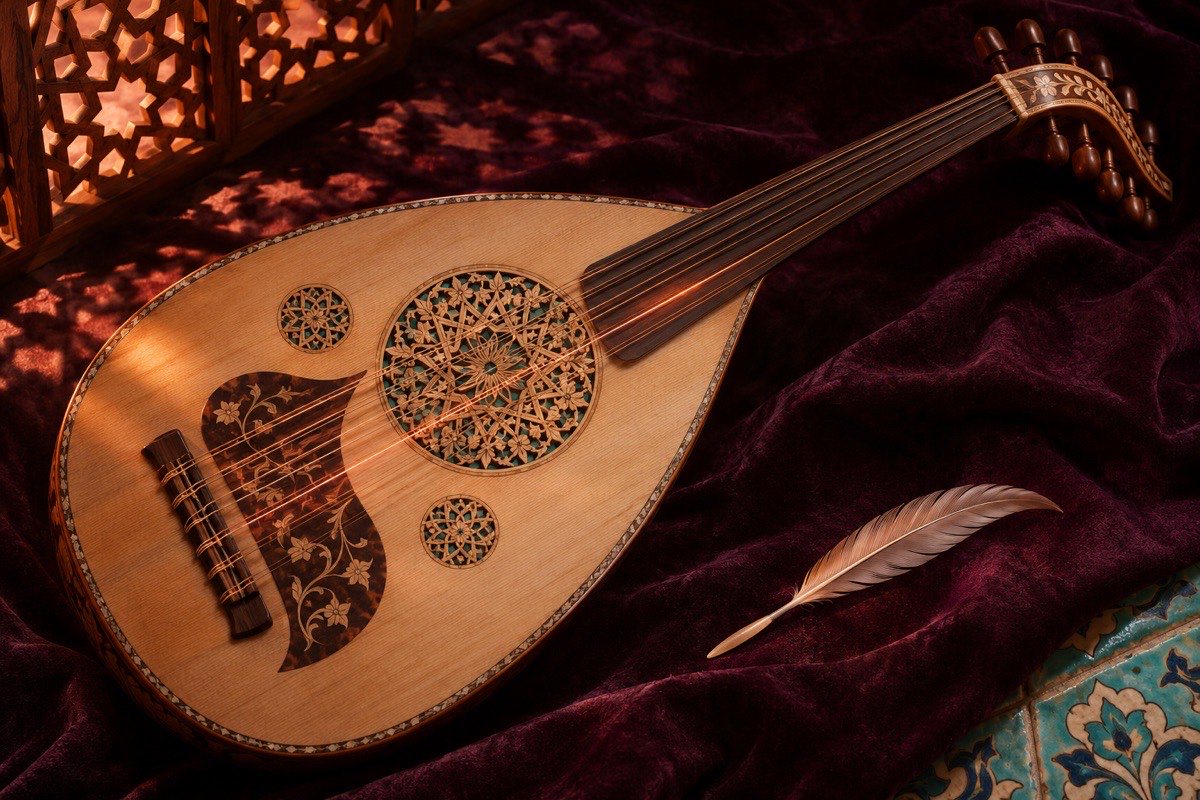
The name comes from the Arabic word ud. If you're wondering how to pronounce oud, it sounds like OOD in English. The instrument itself is a short-necked lute with a pear-shaped body and no frets. These are its defining features, and they help explain the differences discussed throughout this article.
The instrument usually has 11 strings in six courses, or groups of strings that sound together. There are also models with five or seven courses, which means 10 or 13 strings. These are all versions of the same instrument, even though the string count varies. Strings were once made of gut; today, they are made of silk or nylon, or wound with copper or silver.
The oud is played with a plectrum called a risha, which means "feather" in Arabic. The risha was once made from an eagle feather, and its name still reflects the material originally used to make it.
The Origin of the Oud: From the Barbat to Europe
The instrument's direct predecessor is the Persian barbat, so its roots lie in Persia. Different versions are played today in Arab countries, Turkey, and the Balkans. The oldest surviving example is probably in the Musical Instruments Museum in Brussels.
The philosopher al-Kindi provided the first known full description of the instrument and its construction in the 9th century. Sources also credit Ziryab (789 to 857) with adding a fifth string. He founded a music school in Andalusia, one of the places through which the oud traveled from the Islamic world to Europe.
The Western lute developed from the medieval oud of the Islamic world. A basic distinction between the two instruments is still visible today: the oud has no frets, and its neck is shorter.
Oud Tuning
Tuning depends on the tradition and the number of courses. A common modern Arabic tuning is C2 F2 A2 D3 G3 C4. An older pattern is D2 G2 A2 D3 G3 C4, with different notes for the two lowest courses. The remaining four notes, A2 D3 G3 C4, are the same in both tunings.
Each tuning specifies six notes, one per course. Getting the notes right is only the beginning, though, because the strings within each course also need to sound clear together. Tuning therefore takes both patience and a good ear.
Oud vs Guitar: Which Is Harder?
Both instruments have strings that are plucked, and learning to play either takes practice to train the hands and the ear. Still, there are clear differences. The oud has a pear-shaped body, a short neck, and usually 11 strings, while the guitar has frets.
The oud's fretless neck allows players to produce sounds that a fretted guitar cannot offer without modifications. These include microtones and the neutral seconds needed in maqamat. You can read more about this in our article on Arabic maqam scales.
So is the oud harder than the guitar? In our view, the honest answer is that each instrument presents different challenges. On the oud, you must find each note's position and listen carefully to your intonation, because no frets mark where to place your fingers. On the guitar, the frets guide you. Oud beginners start training their ears right away, but that same freedom of finger placement also gives them access to microtones. The choice therefore depends on whether you want to play in maqamat.
The Oud in the Takht Ensemble
The oud is one of the core instruments of the takht ensemble, alongside the qanun, ney, violin, riq, and darbuka. You can learn about the others in our overview of other Arabic music instruments.
The oud has a long history, from the Persian barbat and al-Kindi's description to its place on modern stages in Arab countries, Turkey, and the Balkans. The best way to appreciate how it differs from the guitar is to listen: its sound makes the distinction clearest. Before you buy an instrument, spend some time listening to how it sounds in different styles.